Home
CLM in a Changing World

Understanding CLM Starts with the World the Bank Operates In
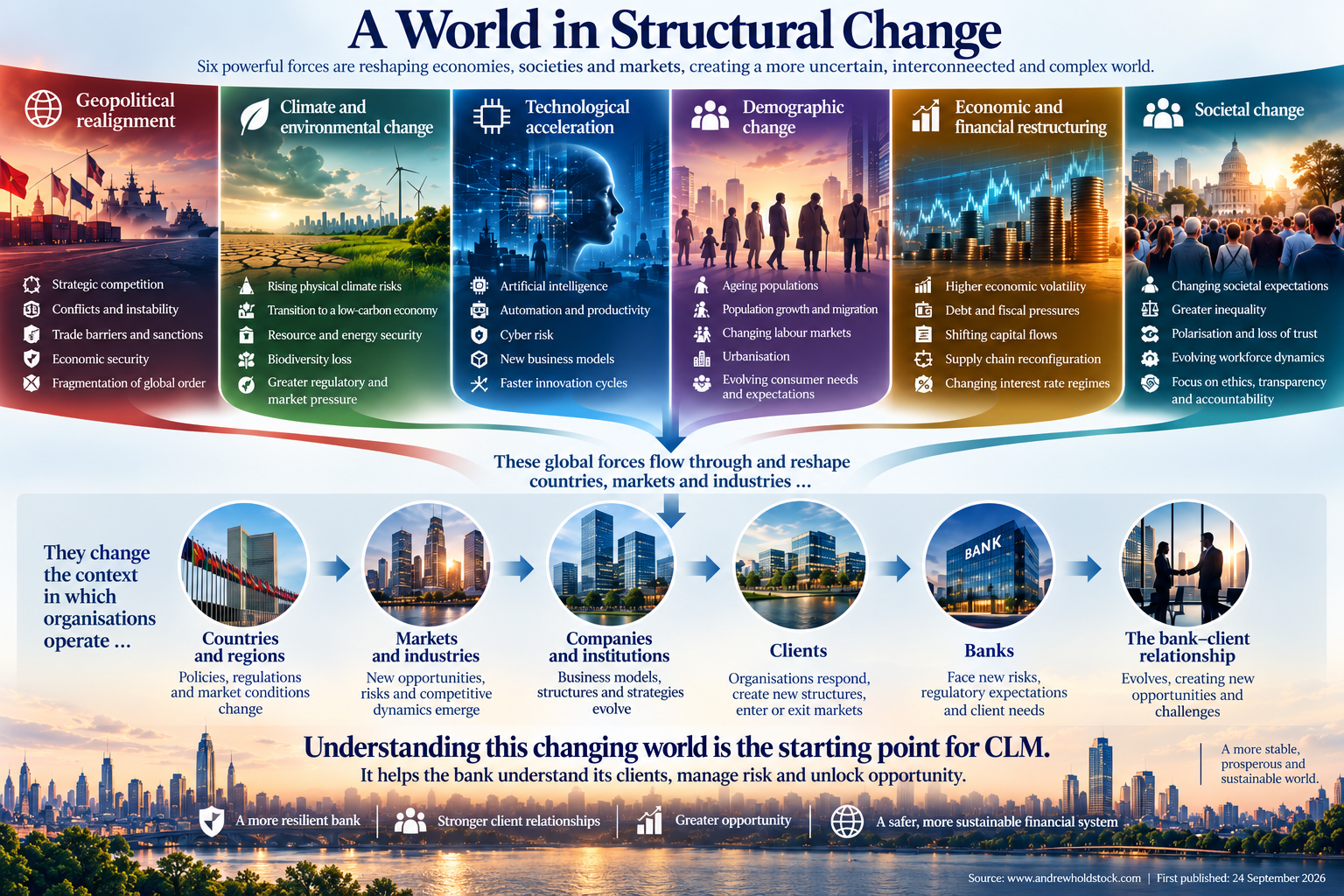
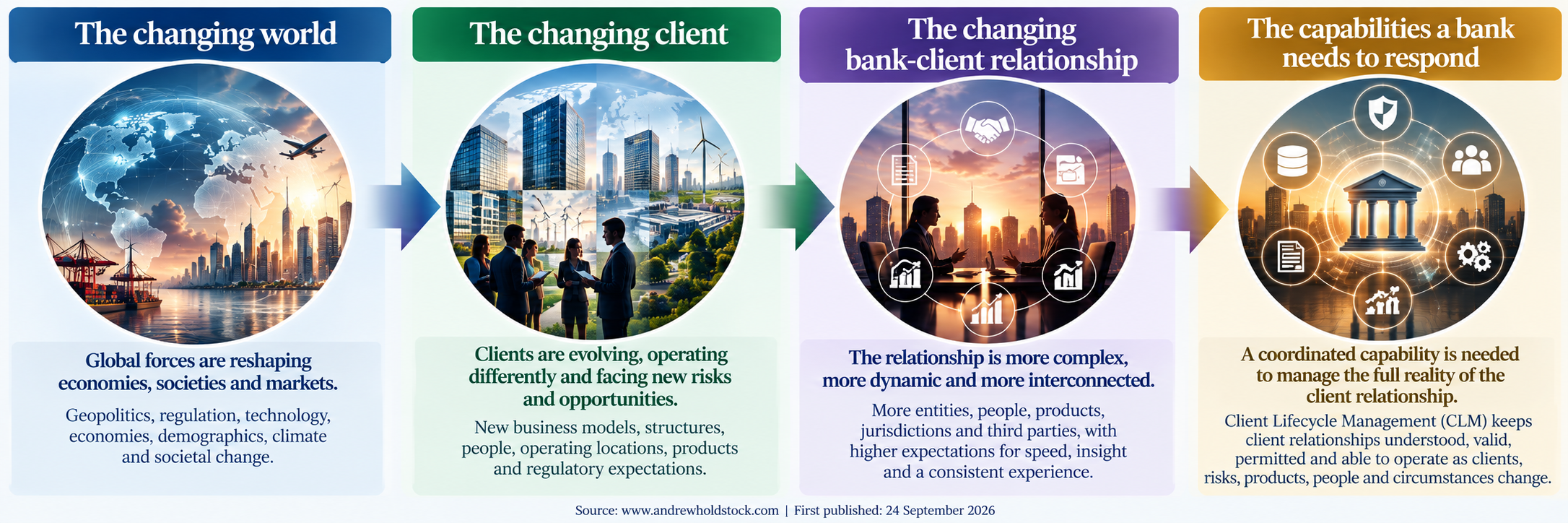
Clients and banks operate in a world shaped by geopolitical change, regulation, technology, economic pressure, demographic shifts, climate risk and changing societal expectations.
Those forces reshape markets, industries and clients. They alter where businesses operate, how they are structured, what risks they face, what services they need and how quickly they need banks to respond.
For a bank, the challenge is not simply to understand the world around it.
It must understand how change in that world flows through its clients and into the relationships the bank is responsible for managing.
That is where Client Lifecycle Management begins.
CLM provides the capability to keep client relationships understood, valid, appropriately permitted and able to operate as clients, risks, products, people and circumstances change.
This site explores that challenge from the outside in:

Why CLM Starts Here
When the World Changes, Banks Must Respond
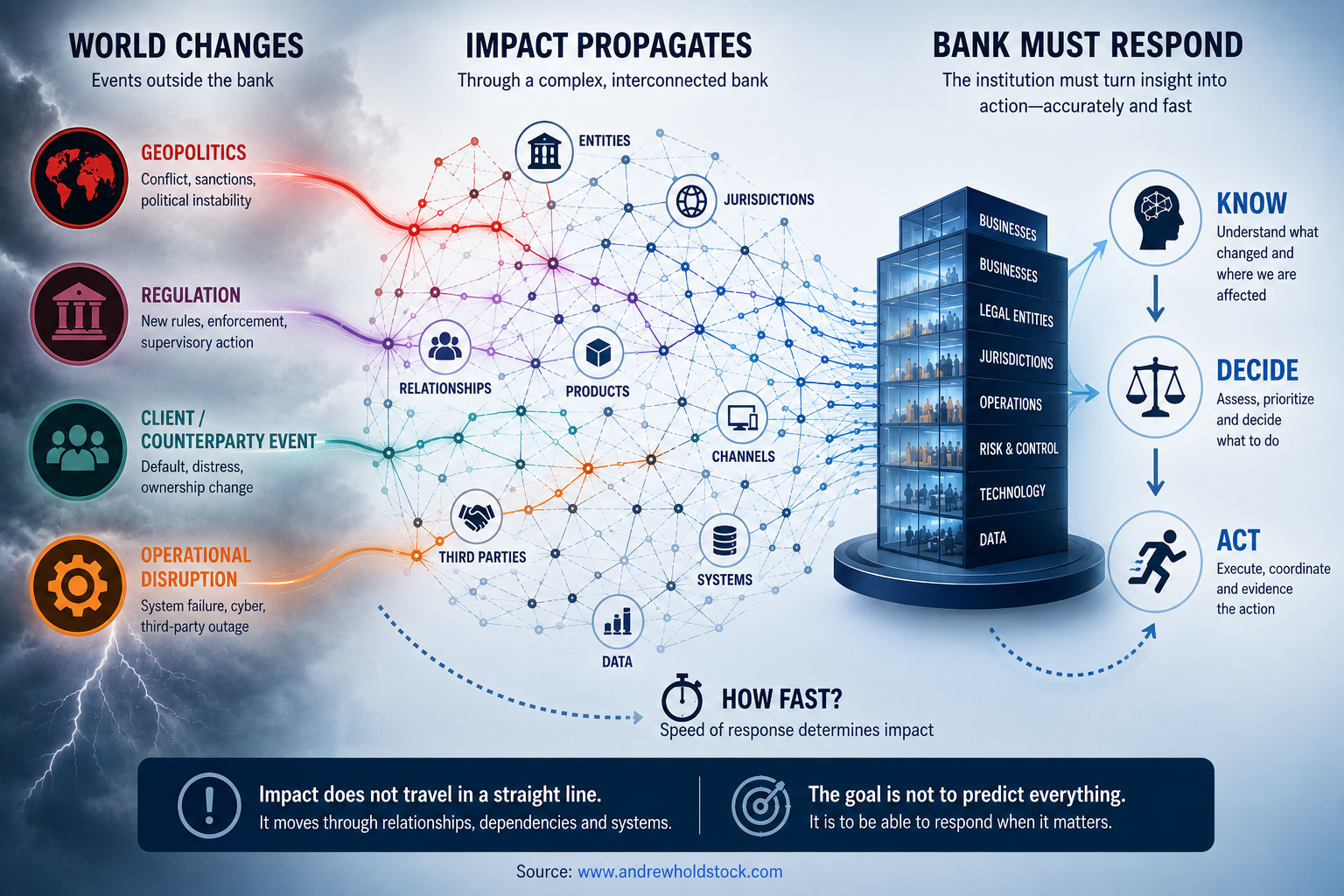
Geopolitical events, regulatory intervention, client or counterparty failure and operational disruption can change a bank’s risk position rapidly.
For a global bank, the critical question is whether it can understand what has changed, determine where it is affected and act before the consequences become material.
The Board needs to know the answer.
The Questions That Matter
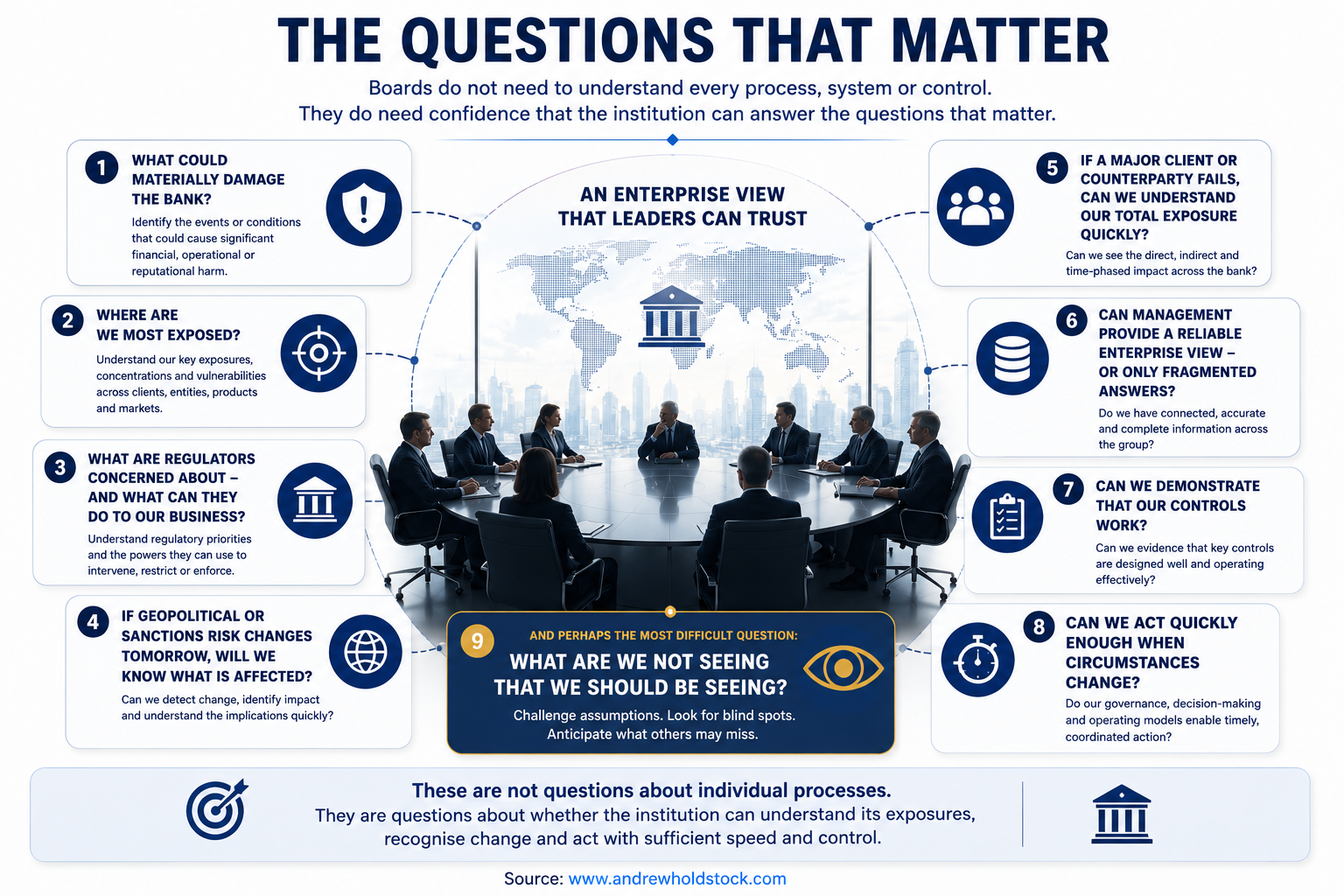
The key questions are whether the bank can understand its exposures, maintain control, and act when circumstances change.
Boards do not need to understand every process, system or control. They do need confidence that the institution can answer the questions that matter.
What could materially damage the bank?
Where are we most exposed?
What are regulators concerned about — and what can they do to our business?
If geopolitical or sanctions risk changes tomorrow, will we know what is affected?
If a major client or counterparty fails, can we understand our total exposure quickly?
Can management provide a reliable enterprise view — or only fragmented answers?
Can we demonstrate that our controls work?
Can we act quickly enough when circumstances change?
What are we not seeing that we should be seeing?
These are not questions about individual processes. They are questions about whether the institution can understand its exposures, recognise change and act with sufficient speed and control.
These are not questions about individual processes. They are questions about whether the institution can understand its exposures, recognise change and act with sufficient speed and control.
What is changing?
A faster-moving, more interconnected environment is changing how risk can emerge and spread across the bank.
The environment around a global bank is becoming more complex, more interconnected and faster moving.
Geopolitical events, regulatory action, market movements, client or counterparty distress, technology failure and third-party disruption can all change the bank’s risk position.
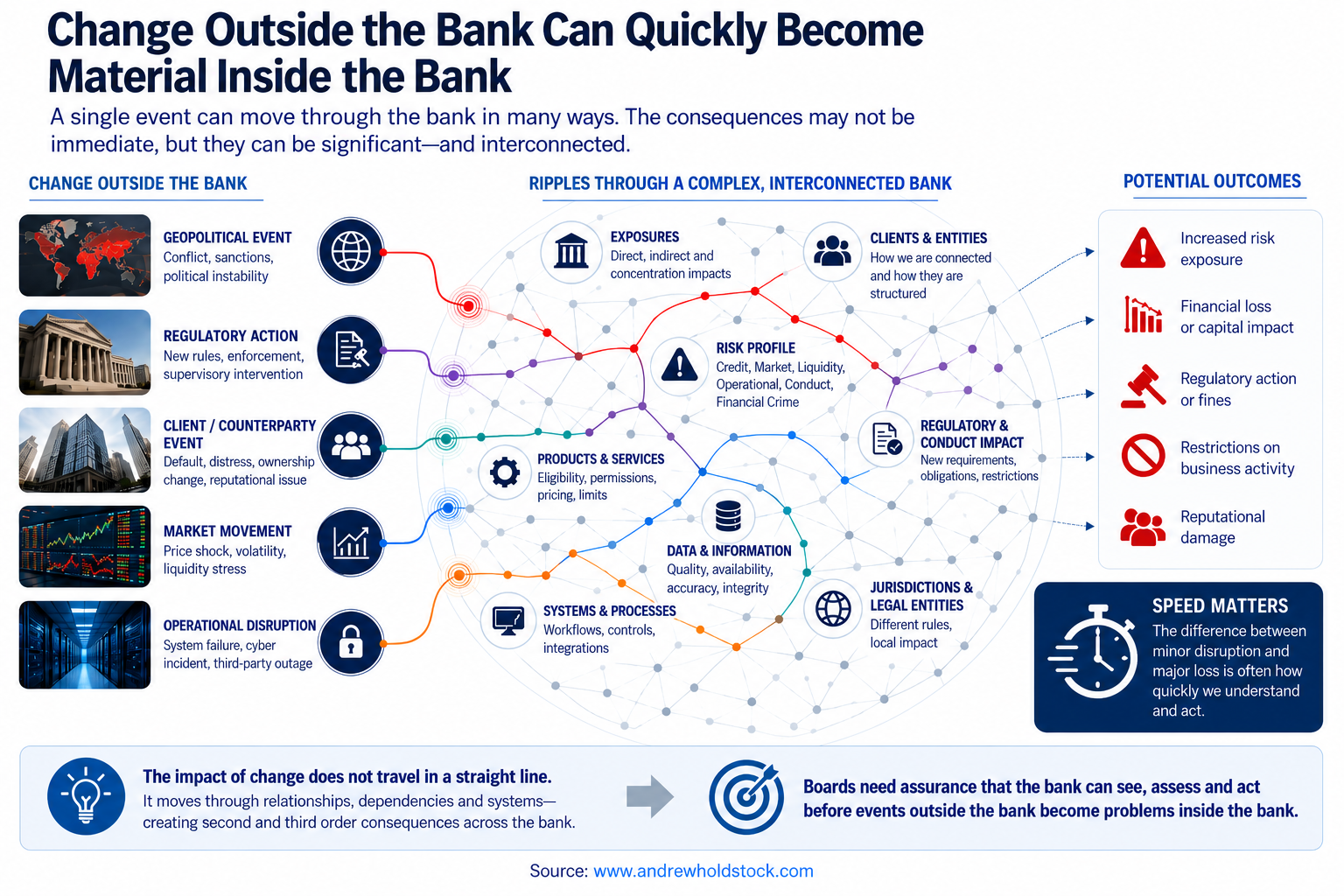
The challenge is that these effects rarely remain confined to one business, system or jurisdiction. They can move through client relationships, legal entities, products, markets, data and operational dependencies in ways that are difficult to see from any single part of the organisation.
The bank therefore needs more than individual risk views. It needs to understand how change affects the institution as a whole.
What are regulators concerned about?
Whether the bank can identify, understand and control risks that could harm the institution, its clients, markets or the wider financial system.
Regulators look beyond individual rules and processes. Their concern is whether a major bank can identify, understand and control risks that could harm the institution, its clients, the markets it operates in or the wider financial system.
That includes financial instability, financial crime, poor risk aggregation, operational failure, weak governance, unreliable data and controls, client or market harm, and an inability to respond effectively under stress.
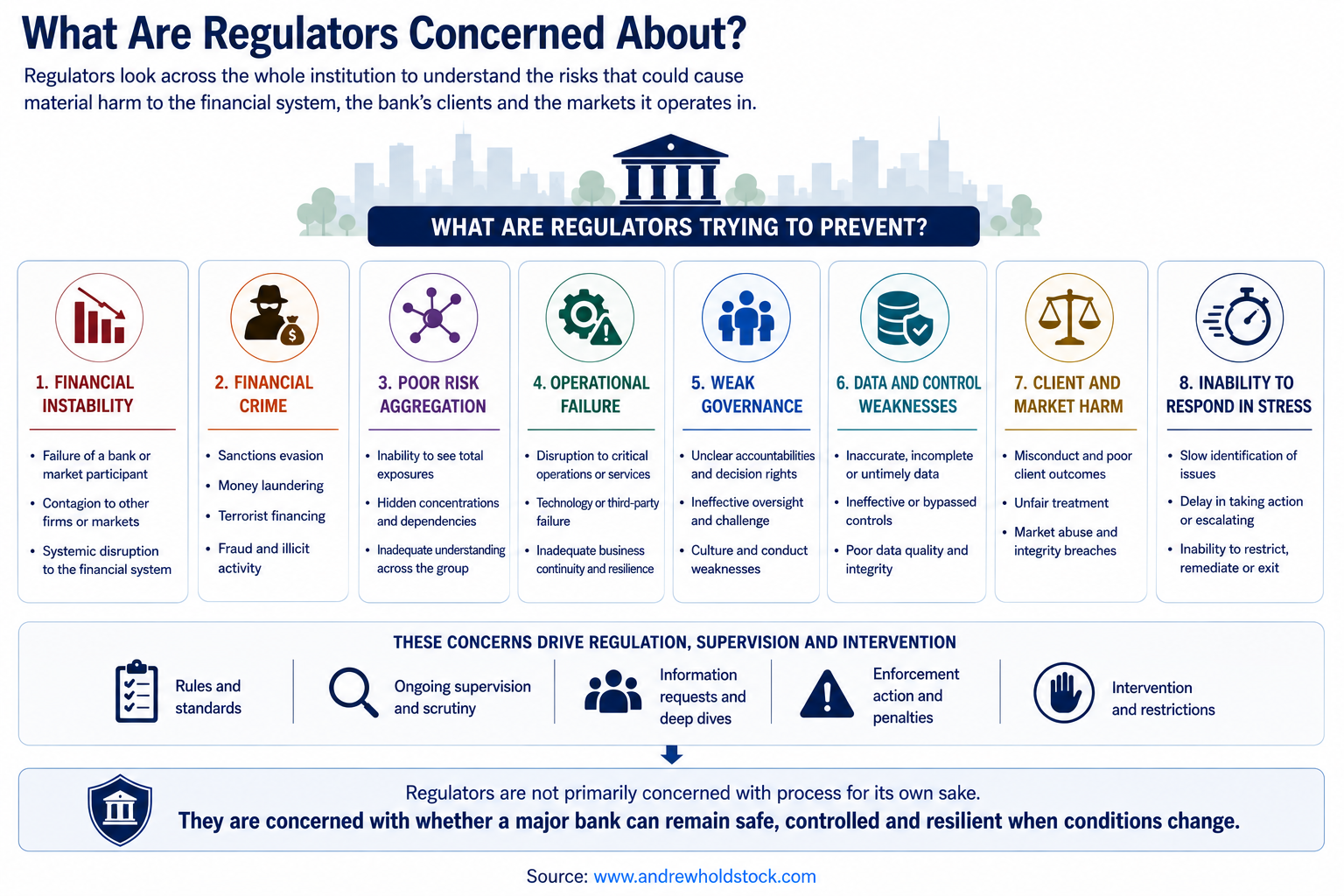
These concerns drive regulation, supervision and, where necessary, intervention.
The underlying question is whether the bank can remain safe, controlled and resilient when conditions change.
What do regulators expect of a G-SIB?
The bank must remain governable, transparent and controllable across the group, even when the wider system is under stress.
A globally systemically important bank is held to a higher standard because its failure could have consequences far beyond the institution itself.
Its scale, cross-border reach, legal entity complexity, market activity and interconnectedness mean that regulators expect it to understand risk across the whole group, produce reliable information quickly, maintain critical services, act decisively under stress and demonstrate clear governance and accountability.
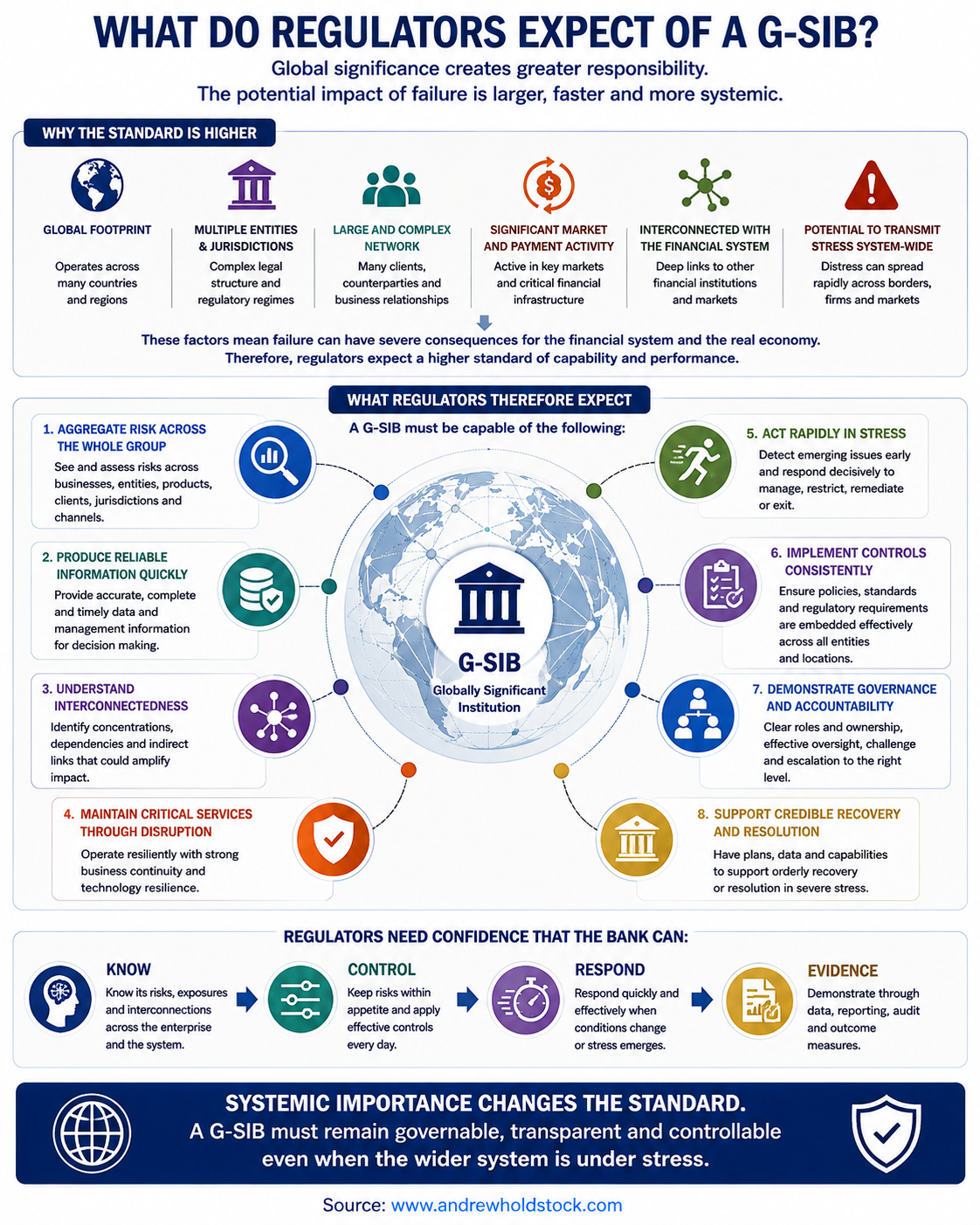
It must also be able to support credible recovery and resolution if severe disruption occurs.
Systemic importance changes the standard: a G-SIB must remain governable, transparent and controllable even when the wider system is under stress.
What happens when a bank gets it wrong
The consequences can extend far beyond fines — into remediation, restriction, lost revenue, reputational damage and reduced strategic freedom.
The visible penalty is often only the beginning.
Serious control failures can lead to major fines and settlements, enforcement action, prosecution, intrusive supervision, imposed monitors, capital add-ons, restrictions on business, licence conditions and, in severe cases, loss of access to critical financial infrastructure.
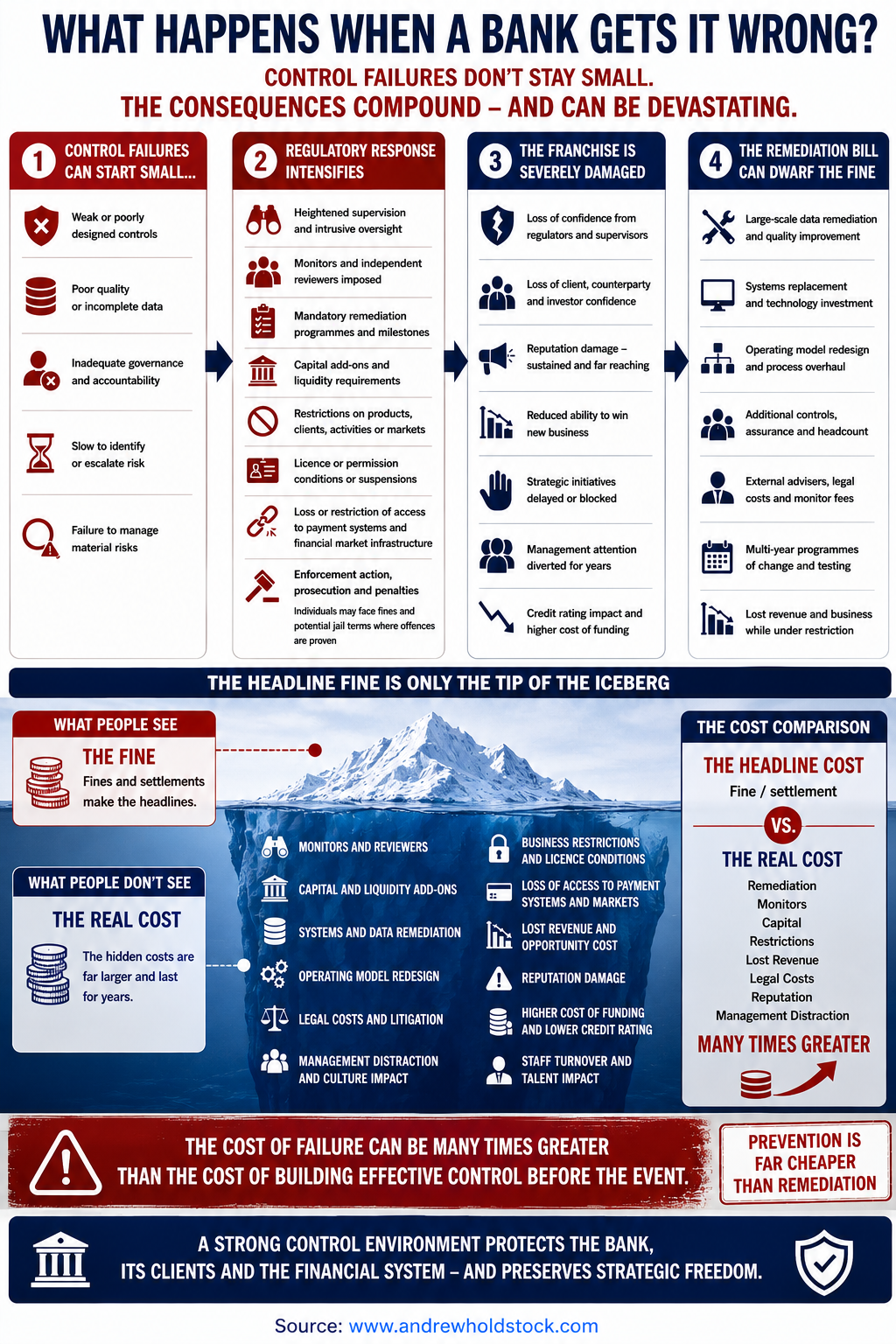
The wider cost can be far greater requiring multi-year remediation, systems and data replacement, additional controls and headcount, legal and advisory fees, lost revenue, management distraction, reputational damage and reduced strategic freedom.
The cost of failure can be many times greater than the cost of building effective control before the event.
What must the bank be able to know?
A reliable enterprise view of who the bank deals with, how they are connected, where exposures sit and what obligations apply.
Effective control depends on the bank being able to form a reliable enterprise view of the parties it deals with, how they are connected, where exposures sit and what obligations apply.
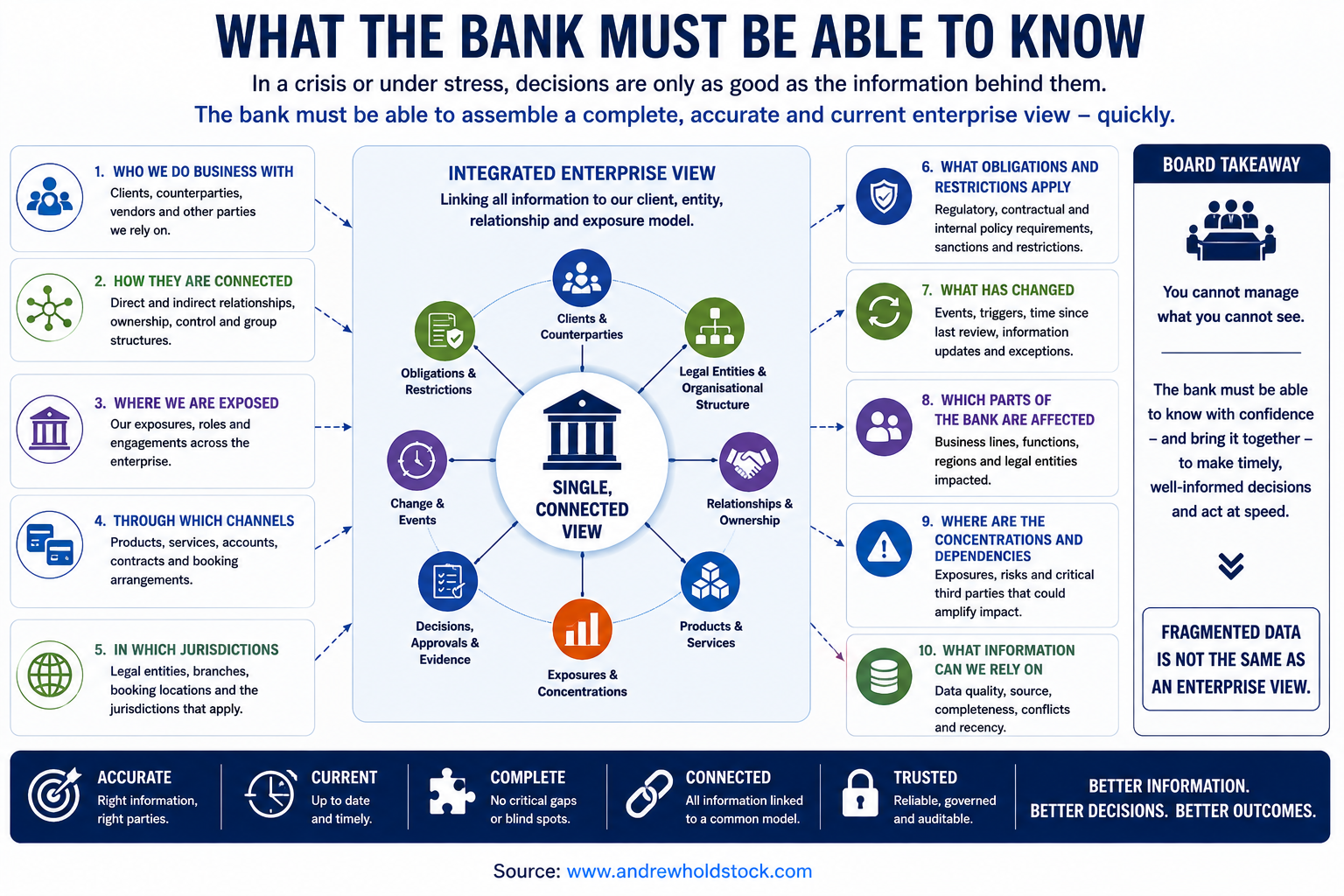
That means understanding clients and counterparties, legal entities and structures, products and services, jurisdictions, relationships, concentrations, dependencies, restrictions, material changes and the decisions already taken.
The information must also be accurate, current, complete, connected and trusted.
Fragmented data is not the same as an enterprise view. When decisions matter, the bank must be able to bring the whole picture together quickly.
What must the bank be able to do?
Identify what matters, decide what to do and act at speed without losing control.
Knowing what has changed is only the start. The bank must be able to turn understanding into controlled action — quickly, consistently and with clear accountability.
That means detecting and understanding events, identifying exposures and vulnerabilities, assessing materiality, prioritising what matters most, taking coordinated action and then monitoring whether the response is working.
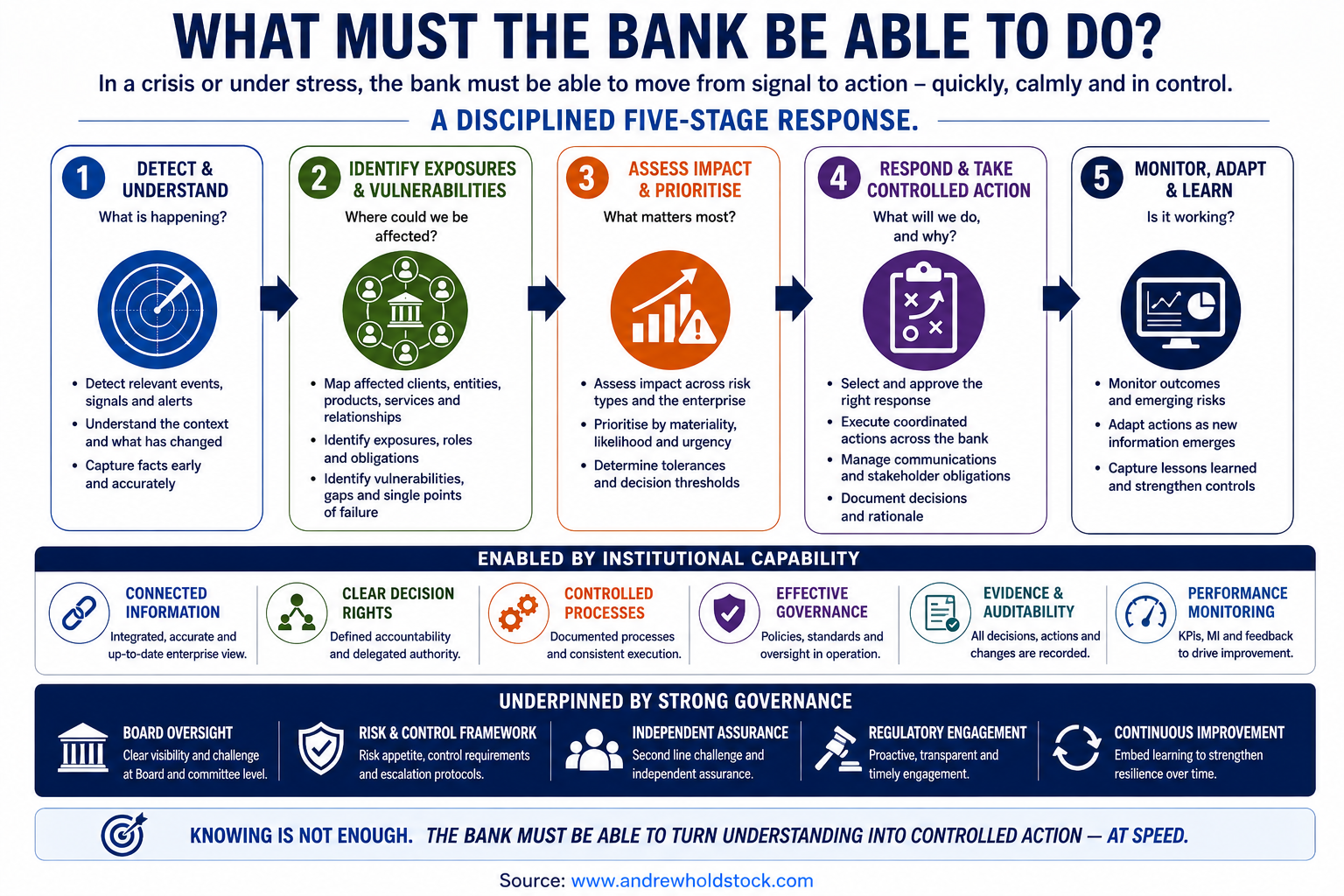
Doing this well depends on connected information, clear decision rights, controlled processes, effective governance, evidence and performance monitoring.
Knowing is not enough. The bank must be able to act at speed without losing control.
The infrastructure behind knowing and acting
CLM connects the client, entity, relationship and control information the bank needs to understand change and act with speed and control.
Much of the bank’s ability to know and act depends on the quality of its client, entity, relationship and control infrastructure. This is where CLM becomes important.
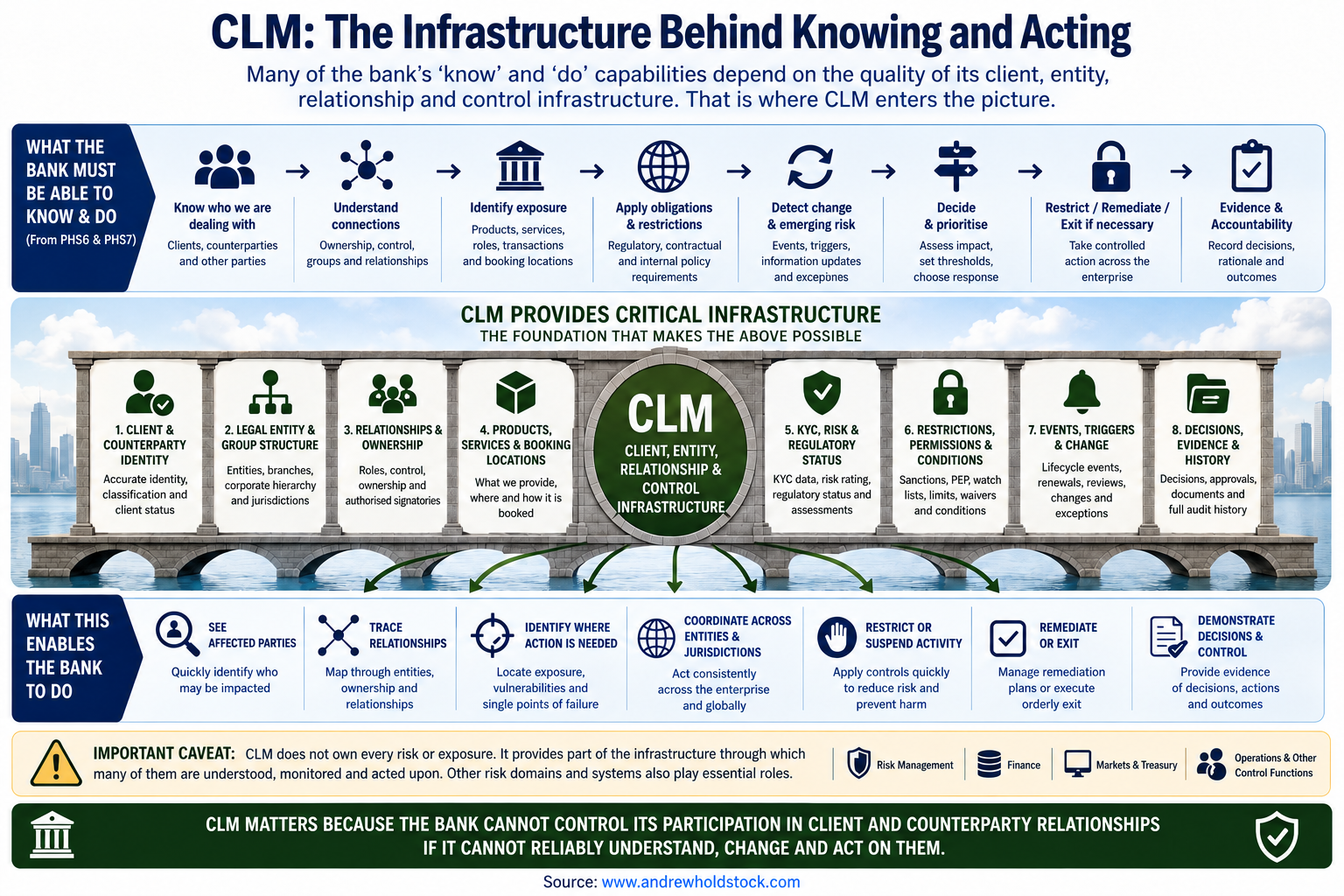
CLM helps the bank understand who it is dealing with, how parties are structured and connected, where and how business is conducted, what requirements and restrictions apply, what has changed and what decisions have already been made.
It also provides mechanisms through which relationships can be reviewed, restricted, remediated or exited, with the decisions and actions appropriately evidenced.
CLM does not own every risk or exposure. It provides part of the infrastructure through which many of them can be understood and acted upon.
CLM matters because the bank cannot control its participation in client and counterparty relationships if it cannot reliably understand, change and act on them.
Different questions. One system.
Different leadership priorities provide different entry points into the same interconnected system.
Different leaders come to these issues from different starting points. A Board member may be concerned about exposure or control; a business leader about customers or growth; an operations leader about performance; and a transformation leader about where to invest.
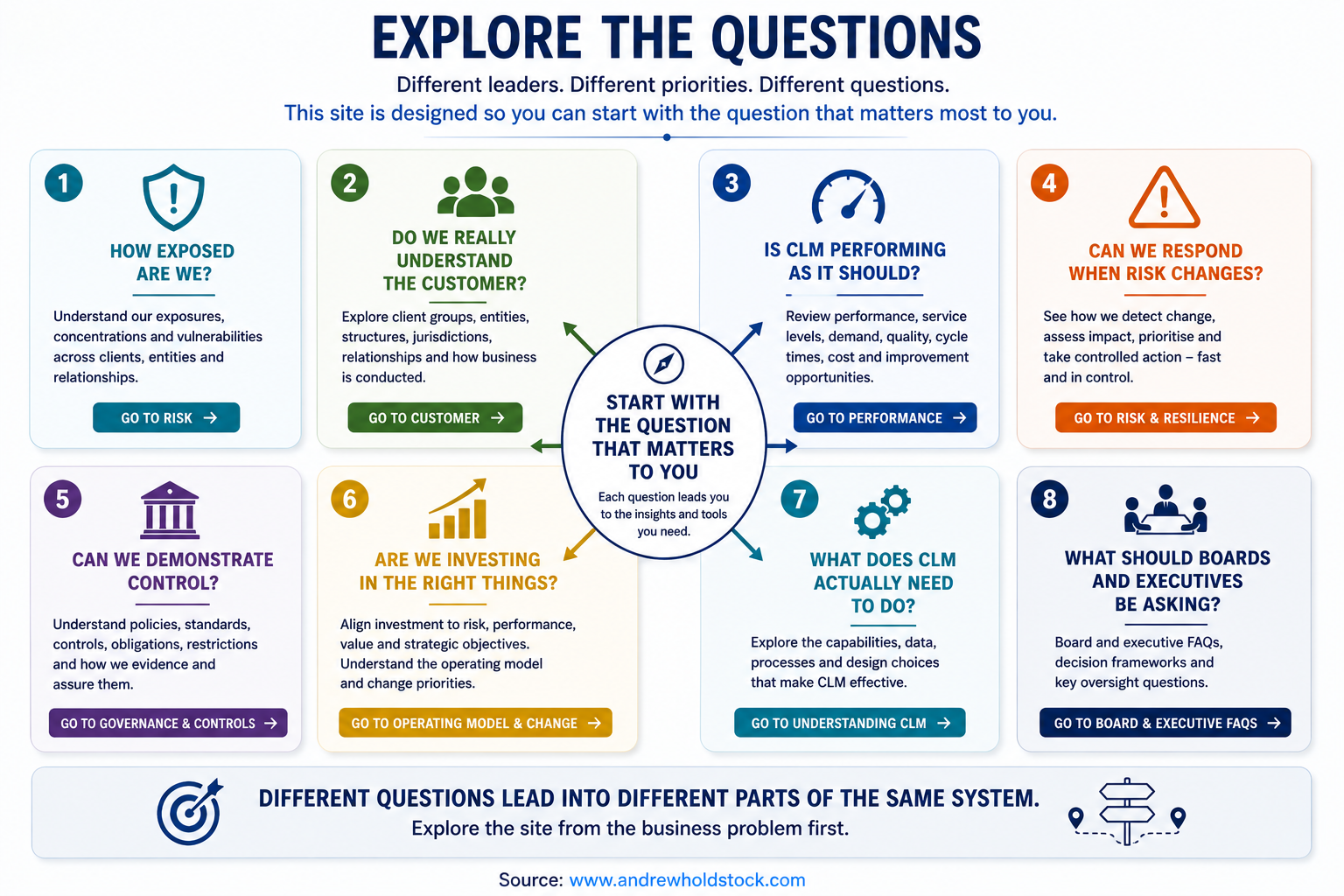
The site is designed to be explored from those business questions rather than through a fixed sequence.
Start with the question that matters to you and follow it into Risk, Customer, Performance, Governance, Resilience, Operating Model or the underlying capabilities of CLM.
Different questions lead into different parts of the same system. Start with the business problem first.
The perspective behind this site.
A systemic view grounded in practical experience across strategy, operating model, transformation, design and execution.
The ideas on this site are grounded in practical experience across strategy, operating model, transformation, design and execution.
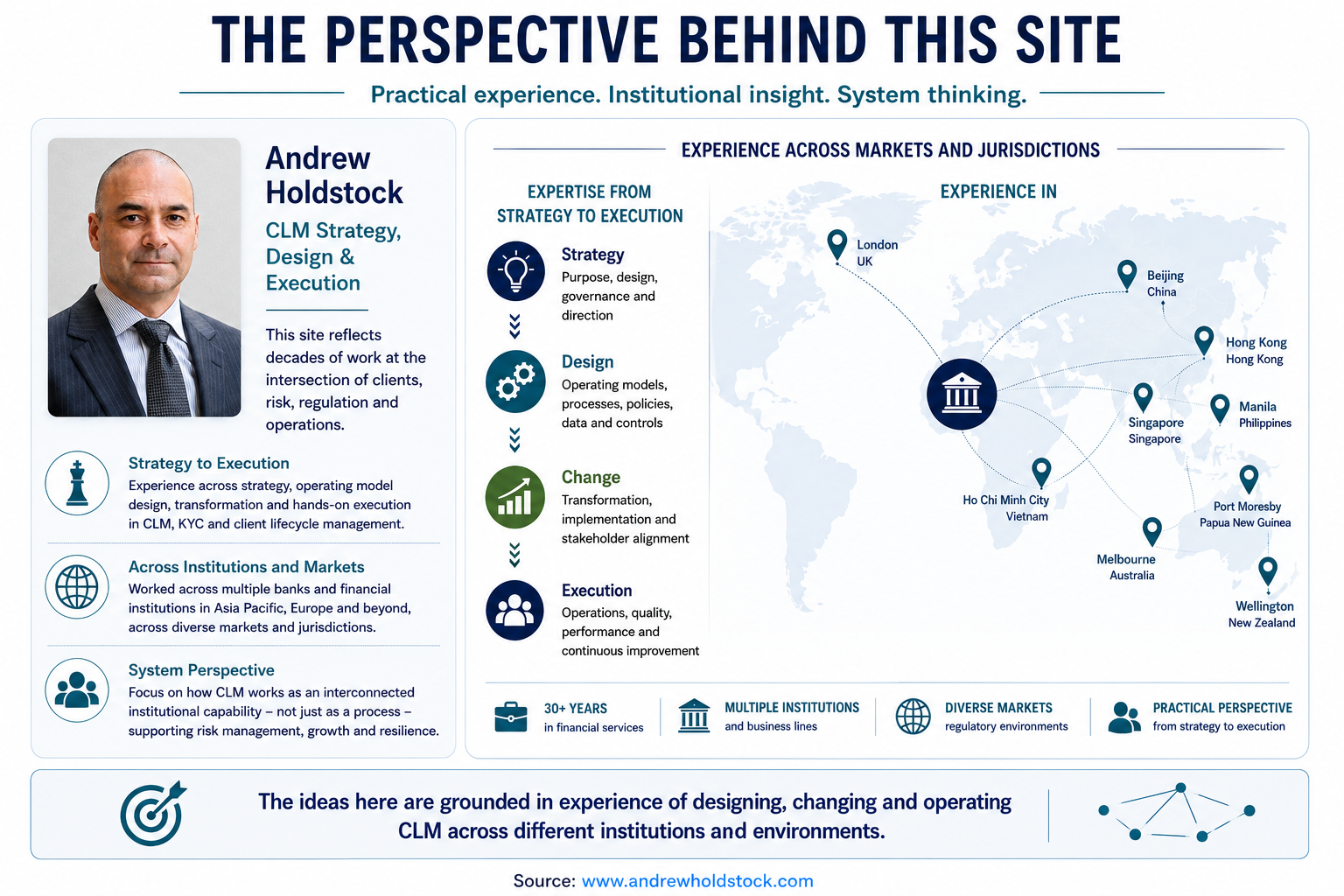
That experience spans multiple institutions, markets and jurisdictions, with a particular focus on how clients, risk, regulation, data, operations and technology come together in practice.
The perspective is deliberately systemic: CLM is treated not simply as a process, but as an interconnected institutional capability supporting control, resilience and growth.
The aim is to connect strategic questions with the practical structures, decisions and capabilities needed to answer them.